
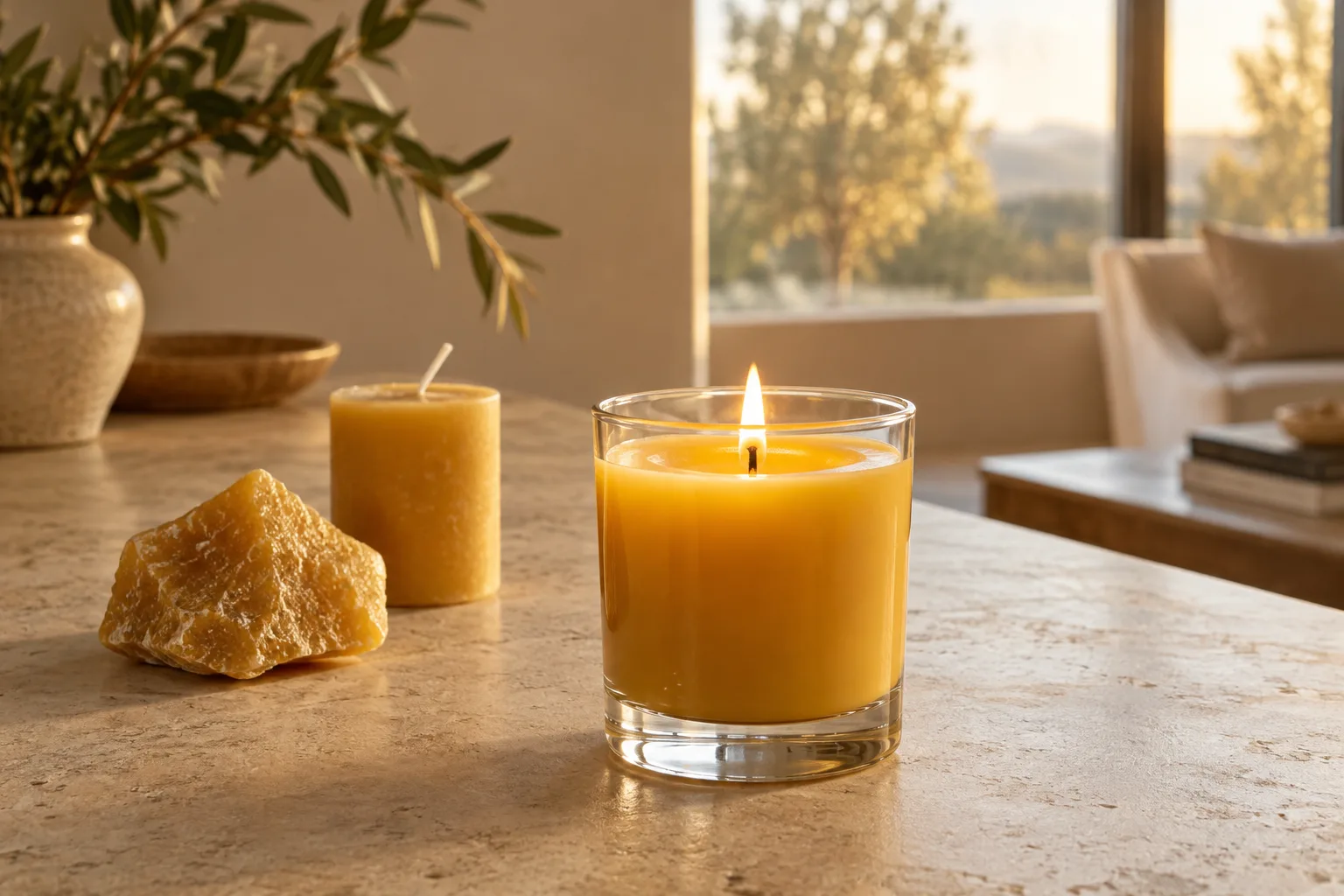
What are beeswax candles benefits and side effects?
Beeswax candles offer warm light, a naturally mild aroma, and wax made by honey bees. Their drawbacks include higher prices, possible soot, and the fire risks shared by all burning candles. They are not proven air purifiers or health treatments; careful product selection and safe use matter more than wellness claims.
Understanding beeswax candles benefits and side effects helps you choose a candle for what it actually delivers: atmosphere, a distinctive natural material, and, with the right purchase, a meaningful gift. The most useful comparison is not “healthy versus toxic,” but ingredients, fragrance, burning conditions, safety, and the purpose behind your purchase.
This guide separates established facts from marketing claims so you can decide whether a beeswax candle belongs in your home or on your gift list.
What makes beeswax different from other candle waxes?
Beeswax is produced by worker honey bees and used to build the comb inside their colony.
Worker honey bees secrete wax and form it into comb. The colony uses those cells to rear young bees and store food. The queen bee does not produce the colony's wax.
Beeswax is therefore an animal-produced material, unlike petroleum-derived paraffin or plant-derived soy wax. That distinction can matter to shoppers who care about the origin of household materials, although it does not by itself prove that one finished candle is safer or more sustainable than another.
Natural beeswax candles can vary in color and aroma because the wax's origin and processing vary. A pale candle is not automatically inferior to a golden one, and color alone cannot establish purity.
What are the practical benefits of burning beeswax candles?
The practical benefits of burning beeswax candles are their atmosphere, material origin, and potential for a subtle aroma without added perfume.
Can beeswax provide fragrance without added scent?
Beeswax can have a mild, honey-like aroma of its own, although its strength varies between products.
This can appeal to someone who dislikes heavily perfumed candles but still enjoys a little natural scent. Check the ingredient description, because a beeswax candle can also contain added fragrance. “Made with beeswax” does not mean fragrance-free.
Why does the material appeal to bee lovers?
Beeswax offers a tangible connection to the comb-building work of honey bees.
For someone interested in bees, gardening, or natural materials, that origin can make a candle feel more personal than a generic home accessory. The benefit is its story and everyday usefulness, not an unproven therapeutic effect.
Are beeswax candles guaranteed to burn longer?
Wax type alone cannot guarantee how long a finished candle will burn.
Candle size, wick design, formulation, and use all affect performance. Compare manufacturer guidance for similarly sized products rather than accepting a universal claim that every beeswax candle outlasts every soy or paraffin candle.
Which beeswax candles benefits and side effects matter indoors?
Indoors, the key trade-off is enjoying candlelight while recognizing that any burning candle is a source of combustion emissions.
The EPA's guidance on indoor particulate matter identifies burning candles as an activity that can generate particles indoors. Beeswax does not make a flame emission-free, and a candle without visible smoke is not necessarily producing no particles.
Can beeswax candles create soot?
Yes, beeswax candles can produce soot, especially when the flame is burning poorly.
A flickering, smoking flame or black deposits on a container are reasons to extinguish the candle and review its care instructions. Drafts, an unsuitable wick, or an excessively long wick can interfere with proper burning. Follow the manufacturer's directions instead of assuming natural wax cannot smoke.
Does natural beeswax make a candle suitable for everyone?
No, a natural material does not guarantee that everyone will find a burning candle comfortable to use.
Some people prefer to avoid all fragrance or indoor combustion. If the recipient dislikes scented products or asks for a smoke-free home, choose a flameless light or a non-burning gift rather than assuming beeswax will be acceptable.
Are air-purifying and negative-ion claims reliable?
There is no established basis for treating a beeswax candle as an air purifier.
Claims that burning beeswax removes household pollutants through negative ions should not guide a purchase. The EPA's indoor-air guidance emphasizes controlling pollutant sources, ventilation with clean outdoor air, and appropriate filtration—not adding another combustion source.
Likewise, beeswax candles health benefits should not be presented as proven simply because the wax is natural. Enjoy a candle for its light and atmosphere, not as a way to detoxify a room or treat a health condition.
How can you choose a beeswax candle without falling for hype?
Choose a candle by checking its wax composition, added fragrance, care instructions, and suitability for the person using it.
Pure beeswax candles and beeswax blends are not interchangeable descriptions. If the listing leaves important details unclear, ask the seller before buying, especially when shopping for someone with strong fragrance preferences.
- Check the wax description: Look for a clear statement about whether the wax is entirely beeswax or a blend.
- Read fragrance information separately: A claim about wax purity does not necessarily explain whether scent has been added.
- Compare equivalent sizes: Consider candle weight, container design, and any stated burn-time guidance together.
- Look for care instructions: Clear guidance about wick maintenance, burn sessions, and when to stop using the candle is useful.
- Ignore sweeping wellness promises: “Chemical-free,” “detoxifying,” and “air-cleaning” are not substitutes for an ingredient description.
- Check the giving program: If conservation matters to you, look for documented contributions, named recipients, and details about the work funded rather than inferring an impact from the wax alone.
For a bee-themed gift, explore Project Honey Bees' Save The Bees™ Beeswax Candle. Check the product page for current availability, size, wax composition, origin, fragrance information, and candle-care guidance.
How do you burn beeswax candles safely?
Use beeswax candles with the same fire precautions you would apply to any open-flame candle.
The U.S. Fire Administration recommends stable holders, keeping candles away from anything that can burn, and extinguishing them when leaving the room or going to bed. Choosing beeswax does not remove these requirements.
- Choose a stable location: Place the candle on a heat-resistant surface where it cannot easily be knocked over.
- Clear nearby materials: Keep the flame away from curtains, paper, decorations, and other combustible items.
- Maintain the wick: Follow the product's trimming instructions before lighting.
- Avoid drafts: Keep candles away from open windows, fans, and strong air currents.
- Stay present: Never leave a burning candle unattended or accessible to children or pets.
- Respect stopping instructions: Do not burn a candle beyond the manufacturer's recommended endpoint.
Let the container and wax cool before handling them. If an open flame is inconvenient or inappropriate for the space, a flameless alternative offers light without candle combustion.
Does buying beeswax help bees and other pollinators?
Buying beeswax does not automatically benefit bee conservation; any benefit depends on sourcing practices and documented conservation contributions.
Honey bees are only one part of the pollinator community. Diverse pollinators need habitat that supplies food and shelter. Supporting managed honey bees and improving habitat for wild bees are not identical actions, and one does not automatically accomplish the other.
Before treating a Project Honey Bees purchase as a conservation contribution, review the brand's current program details. Look for an explanation of what adoption means, whether a purchase funds conservation work, who receives support, and how that support is documented. An adoption or naming offer alone does not establish a conservation outcome.
You can also complement a gift with practical habitat support, such as growing locally appropriate flowering plants. The gift and the garden serve different purposes, and neither needs exaggerated claims to be worthwhile.
What are frequently asked questions about beeswax candles benefits and side effects?
Common questions concern natural aroma, wax purity, indoor emissions, and wellness claims. Beeswax candles offer light and may have a mild scent, but they still require fire precautions and should not be treated as air purifiers or health treatments.
What are the benefits of burning beeswax candles?
Burning beeswax candles provides candlelight and may release a mild natural aroma, depending on the wax and formulation. These are sensory benefits, not evidence that the candle cleans the air or improves health.
What are the benefits of 100% beeswax candles?
A 100% beeswax claim helps shoppers identify the wax material and avoid wax blends if that is their preference. Check fragrance information separately, because wax composition alone may not describe every ingredient in the finished candle.
Do beeswax candles have health benefits?
Beeswax candles should not be purchased as a health treatment or air-cleaning device. Like other burning candles, they can add particles to indoor air, according to the EPA's guidance on indoor particulate matter.
What are beeswax candles spiritual benefits?
Some people use candlelight during reflection, prayer, or personal rituals, giving it an individual spiritual meaning. Those experiences are personal rather than scientifically established effects unique to beeswax.
Ready to choose a bee gift with a purpose?
Start with a gift your recipient will enjoy, then evaluate any conservation claims using the brand's current program details.
For another candle option, explore the Save The Bees™ XL Beeswax Candle and check its current specifications. If a flame is not the right fit, consider a non-burning bee-themed gift instead.
Shop all bee gifts to find a thoughtful match, or review the brand's explanation of how adoption works before choosing. Check the current terms rather than assuming every purchase includes the same adoption offer or conservation contribution.