
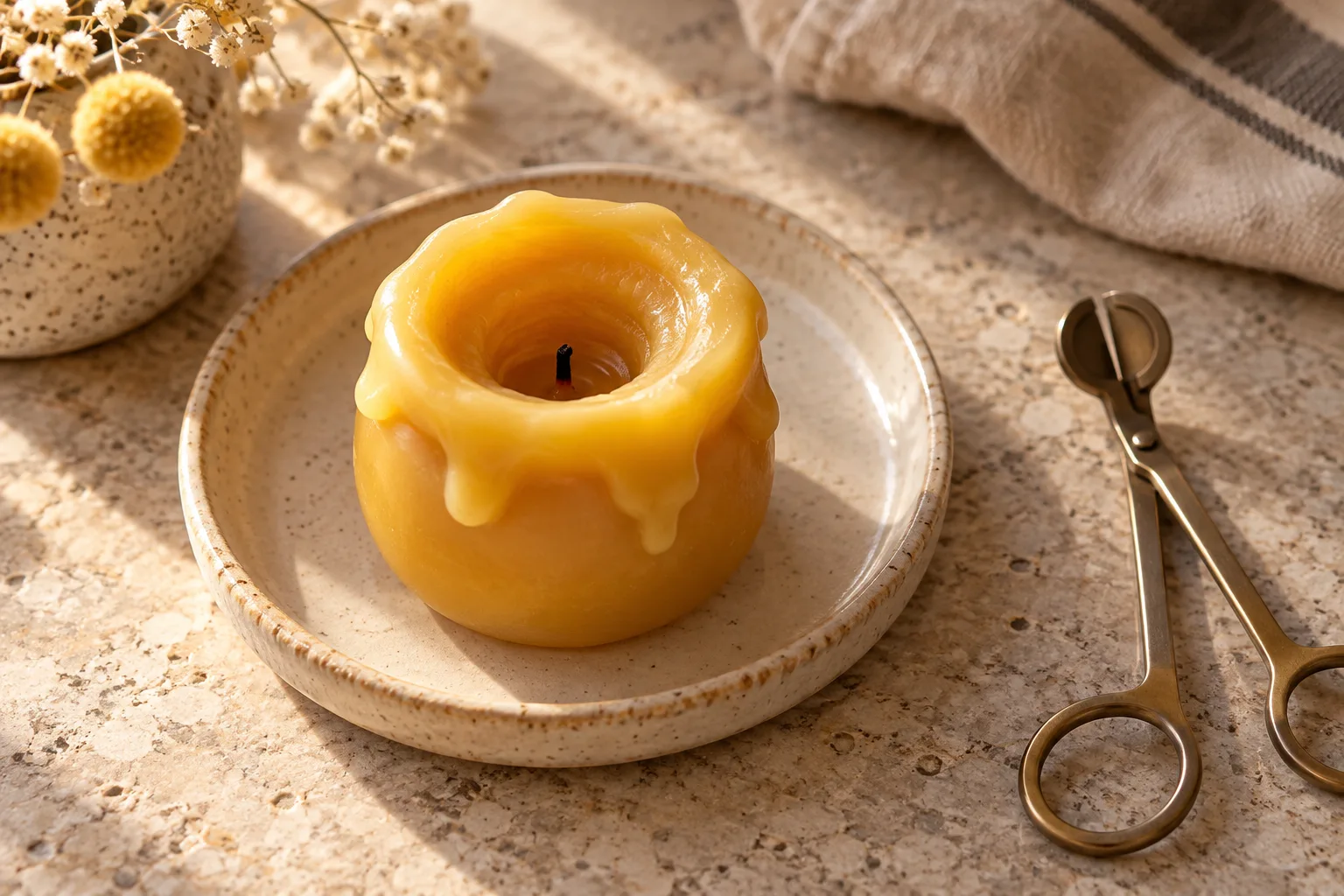
What causes beeswax candle tunneling?
Beeswax candle tunneling happens when the flame melts a narrow channel around the wick while leaving substantial wax along the sides. Short burns can contribute, but wick size, candle design, and drafts also matter. Follow the maker’s burn instructions; a protective wax rim on a pillar candle is not necessarily tunneling.
If your candle is burning straight down the middle, the important question is whether that pattern is expected for its design. A container candle and a freestanding pillar do not always need the same melt-pool shape. Trying to make every candle melt completely across its top can create problems rather than solve them.
This guide explains how to recognize uneven candle burning, what you can safely adjust, and when to stop using a candle. The goal is a stable flame and a candle that performs as intended—not forcing every bit of wax to disappear.
Is a wax rim normal on beeswax pillar candles?

A wax rim can be normal on beeswax pillar candles because the outer wall helps contain the liquid wax.
A pillar stands on its own rather than inside a vessel. Its outer wax can act as a retaining wall while the center burns. Whether that wall should remain intact, soften inward, or receive any maintenance depends on the candle’s design and the maker’s directions.
A container candle has a vessel to hold its melted wax. A deep, narrowing well that leaves thick layers on the container walls and begins to bury the wick is more suggestive of a performance problem. Even then, a small amount of wax left on the sides early in the candle’s life does not automatically require intervention.
- Potentially normal: A pillar has an intact outer wall, a steady flame, and a central melt pool consistent with its instructions.
- Worth checking: The well becomes progressively deeper and narrower, leaving the flame struggling below the surrounding wax.
- Stop and assess: The candle leaks, its container cracks, the flame becomes unusually large, or visible smoking persists.
Do not cut or reshape a pillar’s walls while it is burning. Perform any wax-wall maintenance only as directed by the manufacturer after extinguishing the flame. Hot wax and an unsupported wax wall can spill unexpectedly.
Why does a beeswax candle burn unevenly?
Uneven burning usually reflects how heat reaches the wax, which depends on the wick, burn conditions, and candle construction.
Can short burns cause candle tunneling?
Repeated short burns can leave a small central melt area that develops into a deeper well over later uses.
If a candle is repeatedly extinguished before its intended melt pool develops, wax around the perimeter can remain untouched. However, there is no single candle burn time that suits every width, wick, and shape. Use the product’s instructions rather than an internet formula based only on diameter.
Can the wrong wick cause tunneling?
A wick that does not provide enough heat for a particular candle design can contribute to a narrow melt pool.
Wick performance depends on more than its visible thickness: material, construction, wax formulation, and candle dimensions all interact. If tunneling continues despite correct use, the manufacturer is better placed to assess a possible wick or design mismatch. Replacing a wick in a finished candle is not a routine consumer fix.
Do drafts affect how a candle burns?
Drafts can disturb the flame and make heating less even.
Fans, open windows, and heating or cooling vents can push a flame toward one side. The National Candle Association recommends keeping burning candles away from drafts and air currents. A stable, level location also helps keep liquid wax from collecting disproportionately on one side.
How can you fix beeswax candle tunneling safely?
You may improve mild tunneling by correcting burn conditions, but a deeply tunneled candle may need manufacturer guidance rather than a home repair.
The safest approach to how to fix a tunneling candle starts with its label. Some candles can gradually use more side wax during normal, correctly timed burns; others will not recover because the underlying issue is their wick or construction. Longer burning is not automatically better.
- Let the candle cool completely. Do not handle a hot vessel, dig around a burning wick, or move liquid wax.
- Read the care directions. Check the recommended wick length, permitted burn duration, and stopping point near the candle’s base.
- Prepare the wick as directed. Remove loose trimming debris before lighting. Do not cut an already short or buried wick even shorter.
- Choose a suitable location. Use a stable, heat-resistant surface away from drafts and combustible objects.
- Try a normal, supervised burn. Allow the candle to operate within its stated instructions, without exceeding its maximum burn duration to chase a wider melt pool.
- Stop if performance remains poor. If the flame struggles, repeatedly goes out, smokes persistently, or behaves abnormally, extinguish it and contact the seller.
For a candle gift, explore Project Honey Bees’ Save The Bees™ Beeswax Candle. Check the product listing for current specifications and follow the care instructions supplied with the candle rather than assuming that advice for another size or brand applies.
Should you use foil or a heat gun on a tunneled candle?
Do not improvise with foil covers, heat guns, ovens, or other external heating methods unless the candle manufacturer explicitly approves a specific procedure.
Online fixes often aim to melt the outer wax rapidly, but they also change how heat accumulates around the candle. A vessel designed for normal candle use is not automatically suitable for an oven, microwave, or concentrated blast of hot air. Foil can also obscure the flame and make its behavior harder to monitor.
A safer default is to stop, cool the candle, and ask the maker for advice. Never add water to hot wax or use water to extinguish a candle. The National Candle Association specifically warns that water can cause hot wax to splatter and may break a glass container.
A little unused wax is preferable to an unsafe rescue attempt. Do not keep relighting a candle whose wick has become inaccessible, whose vessel is damaged, or whose remaining wax has reached the manufacturer’s stopping point.
How can you prevent beeswax candle tunneling?

You can reduce the risk of tunneling by choosing a candle suited to your routine and following its instructions consistently from the first use, but care alone cannot correct every wick or design problem.
Before buying, check whether you can realistically provide the recommended supervised burn time. If you usually have only a brief window to enjoy candlelight, ask the seller which candle design fits that routine. A smaller candle may have different requirements, but size alone does not determine the right burn duration.
Good beeswax candle care also means checking the wick before each use. Wick trimming should follow the manufacturer’s specified length; an excessively short wick can struggle to sustain a useful flame. Keep matches, wick fragments, and other debris out of the wax.
For candle safety, the U.S. Fire Administration recommends keeping lit candles at least 12 inches from anything that can burn and extinguishing them when leaving the room or going to bed. Keep candles out of reach of children and pets. These precautions take priority over achieving a particular melt-pool width.
What are frequently asked questions about beeswax candle tunneling?
Common questions concern what causes tunneling, whether it can resolve during normal use, how long to burn a candle, and whether removing wax is safe.
Why is my beeswax candle tunneling?
A narrow melt channel can develop from repeated short burns, an unsuitable wick, drafts, or the candle’s construction. First check whether it is a pillar designed to retain an outer wax wall, then compare your use with the maker’s instructions.
Will candle tunneling fix itself?
Mild side-wax buildup may diminish during later burns that follow the manufacturer’s directions, but deep tunneling is not guaranteed to correct itself. Do not exceed the recommended burn duration in an attempt to force recovery.
How long should you burn a beeswax candle?
Burn a beeswax candle for the duration specified by its manufacturer, staying within any maximum limit. There is no universal timing rule that safely covers every container, pillar, diameter, and wick.
Should I pour wax out of my candle?
Do not pour out hot wax as a general tunneling fix; handling it can cause burns and spills. If excess wax appears to be drowning the wick, extinguish the candle, let it cool, and ask the manufacturer for product-specific guidance.
Where can you shop for bee gifts with a purpose?
You can explore bee-themed gifts at Project Honey Bees and review its adoption information before deciding whether a purchase fits your conservation goals.
If you prefer a gift without candle-care considerations, explore the Adopt A Bee® Gift Set. Check the current product and adoption information for what is included and any stated conservation contributions.
Start with Shop all bee gifts to find something meaningful for yourself or someone else, and learn how adoption works before choosing your favorite.